Yesterday the Textile Museum presented a program about the Stories We Wear, the current Philadelphia Museum of anthro exhibit, which opened yesterday.
The presenter, Dr Anne Tiballi, was an advisor on selection and presentation, from the museum collection.
Ranging all over the place, and including many ethnic groups and cultures, it was respectful of the materials and the garments' significance in their cultures.
 Here's the underlying focus of the approach
And the location and context of the exhibit, and the presenter
Work and Play, Battle, Perform, Ceremony and Rule, are the divisions of examination. The sad choice of font is not the fault of the presenter. She's not a curator. She did make a point of reading them aloud.
Moving along
These are not strictly textiles, the one above being beaten gold, but samples of the high art of people we may not know much about.
Starting in Mongolia, here's the clothing signifying the married nomad woman, pieced and voluminous, designed for horseback riding and with many pockets to accommodate the items that travel with her.
The hairstyle shows her married status, and the style of her coat designates her group. Each tribal or family group has a distinct style of detail.
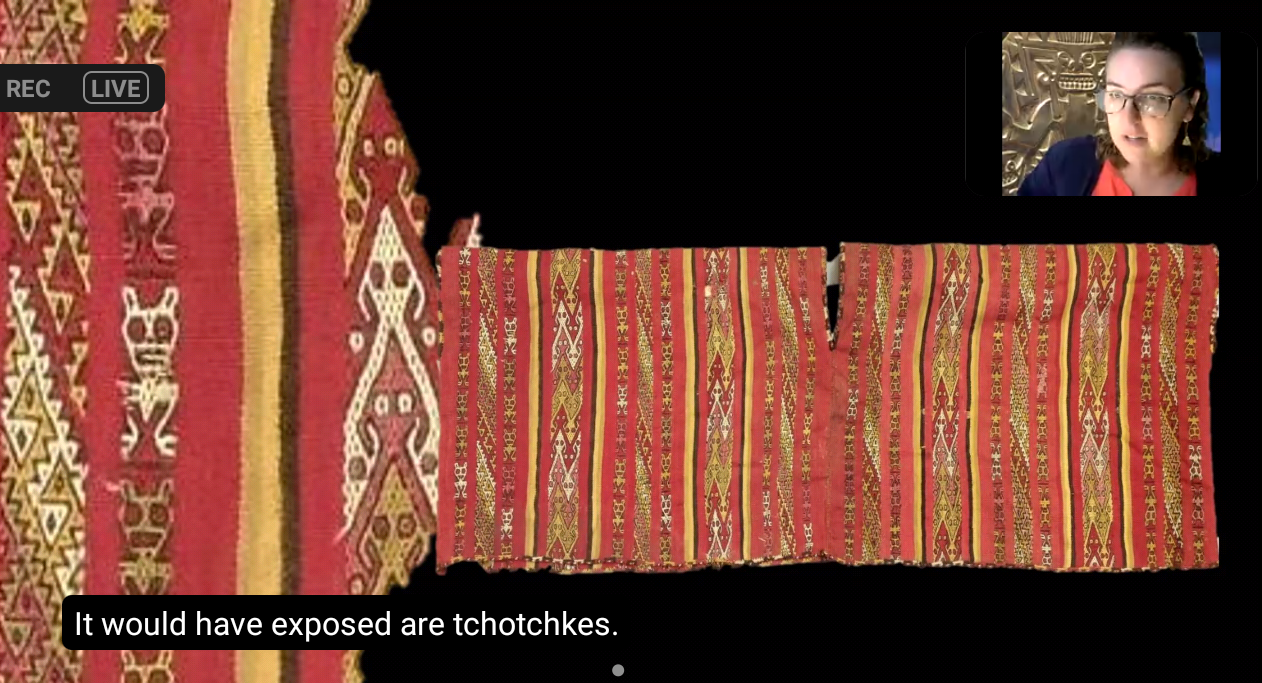
Now to South America, to the messenger, courier runner, who carried vital information long distances across the Inca empire, in relay fashion, blowing his horn to announce his arrival at the next stage, to alert his replacement
He carried a sling for self defense and I wonder if he did a bit of small game food hunting, too, with it. She didn't say.
Here's the knotted string calculator message device. Numbers are recorded by means of the position of the knots, understood by the recipient they're going to, and very secure and portable
And here's a messenger blowing his horn as he runs on a road like this one. Then, to the southwest US
The groom's family were responsible for weaving the white garments for the bride, from scratch, as part of the wedding ceremony, while the bride's people provided food for the guests.
Hence the several days of the ceremony, to finish the weaving and present the clothes to the bride to take to her married home, in a special case.
The significance of fringes is rain, all important in that dry region, while the colors in the clothes reflect fertility, the red meaning the placenta. Corn husks are also incorporated as fertility symbols.
Then we swerve across to an area of atolls in the Pacific, spread over enormous ocean areas, to meet the Kiribati Warrior
The armor is made from coconut fiber, lightweight and available. A lot of the battles are more ceremonial than deadly, killing being a big mistake. Wounding to satisfy honor is the tradition.
These knots in the coir are tough and I wonder if they're like weaver's knots. Please let us know, weavers, if so
Puffer fish helmets, which were effective in keeping off the opposition since the spikes can catch on and tear the coconut fiber armor, also tangle the aggressor.
Here are modern anthropologists creating facsimiles and testing them in use. The originals are too fragile to handle.
A dizzying trip around the planet, but I learned quite a bit. The Textile Museum unfailingly has professional production and preparation.
They're talking about continuing online events even after in-person comes back. Since they routinely get hundreds of participants on Zoom, yesterday 42 countries, I hope they'll continue.
 Here's the underlying focus of the approach